


Table of Contents
- What All Day Support Actually Means in Men's Underwear
- Quick Comparison: Support Features That Matter
- Men's Boxer Briefs with Pouch: Why Separation Changes Everything
- How to Choose Supportive Underwear: A Practical Checklist
- Moisture-Wicking Underwear for Men: Fabric Technology Explained
- Helux Gear Boxer Briefs: A Closer Look at the 2nd Edition
- Medical-Grade vs. Lifestyle Support: What Most Guides Miss
- Conclusion
- Frequently Asked Questions
Last Updated: September 13, 2026
What All Day Support Actually Means in Men's Underwear
Most men treat support as a vague feeling, not a specification. In underwear terms, support is a garment's ability to hold the anatomy stable and comfortable through sitting, standing, walking, and sweating without shifting, pinching, or losing shape.
This guide from Helux Gear breaks down what actually delivers best underwear for all day support, from pouch construction to fabric weight, so you can choose on evidence.
Three things create genuine all-day support: an anatomical pouch that separates rather than compresses, a fabric with enough stretch recovery to hold shape past hour ten, and a waistband that does not roll or dig. Miss one and you feel it by mid-afternoon.
Quick Comparison: Support Features That Matter
The table below maps the features that separate a supportive boxer brief from one that merely fits.

| Feature | What It Does | Why It Matters Daily |
|---|---|---|
| Anatomical pouch | Holds anatomy forward and separate | Reduces friction and skin-on-skin contact |
| Flatlock seams | Lie flat against the skin | Prevents chafing at the inner thigh |
| Long leg cut | Grips the thigh without riding up | Stops bunching during movement |
| Moisture-wicking fabric | Moves sweat away from skin | Keeps temperature stable and reduces odor |
| Stretch recovery | Returns to shape after stretching | Maintains ergonomic fit past hour ten |
| Durable waistband | Holds position without rolling | Prevents constant readjustment |
A common mistake is prioritizing softness alone: fabric that stretches out by lunchtime feels great for two hours and useless for the next eight.
Men's Boxer Briefs with Pouch: Why Separation Changes Everything
Separation is the biggest upgrade available in men's underwear, and the feature most cheap pairs skip. A pouch holds the anatomy forward and away from the thighs rather than compressing it against them, removing the two most common daily complaints: chafing and ride-up.
"Pouch" is not a standardized term: two garments can both claim an anatomical pouch and perform completely differently. The difference comes down to three measurements:
- Pouch depth, how far the fabric extends forward from the body. Too shallow and the anatomy compresses against the thighs anyway. Too deep and the fabric bunches, creating friction points.
- Pouch angle, the direction the pouch holds the anatomy. A downward angle reduces support during movement; a forward-and-slightly-up angle keeps things stable through sitting, standing, and walking.
- Pouch attachment, whether the pouch is cut as part of the front panel or sewn on as a separate piece. Sewn-on pouches can twist or shift; integrated pouches hold their geometry better through washing and wear.
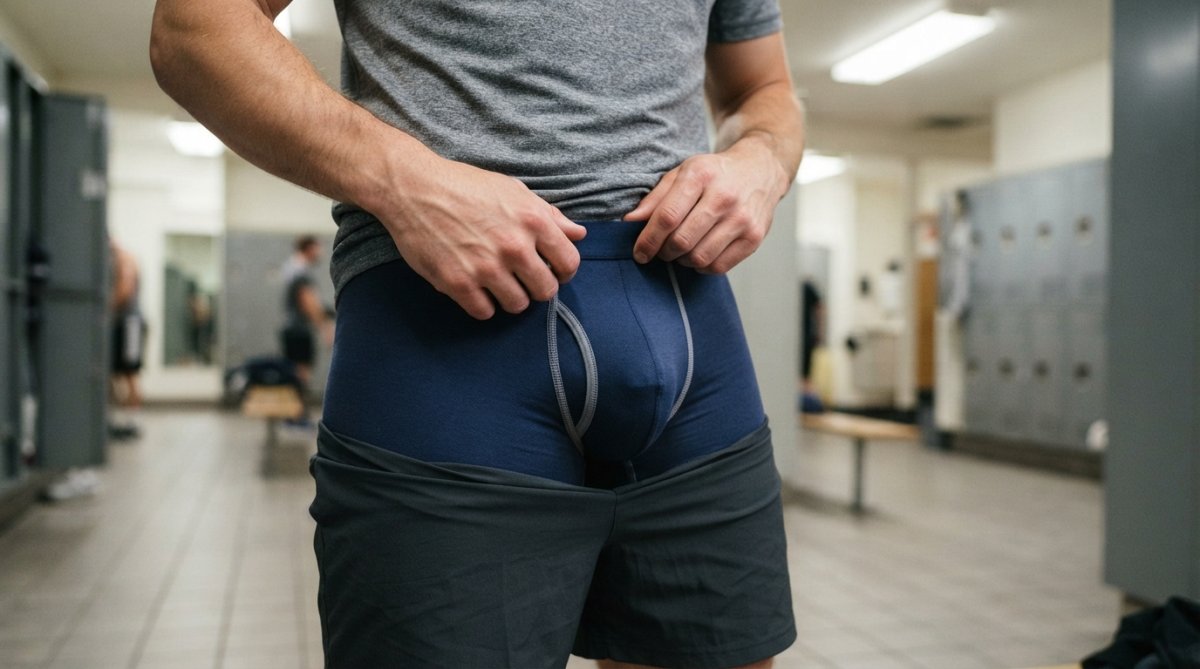
How Pouch Design Prevents Chafing and Ride-Up
Chafing happens when skin rubs against skin or a seam under friction and moisture. A pouch removes skin-on-skin contact, while flatlock seams sit flush so nothing catches. Ride-up happens when fabric loses its grip on the thigh; a longer leg cut plus spandex keeps the hem in place.
Construction quality varies enormously: a shallow pouch is just a seam with a fancy name. Look for a pouch cut to hold shape, not one that stretches flat when worn. A useful test: turn the garment inside out. A single flat piece with a curved seam will flatten when worn; a multi-panel construction with a defined three-dimensional shape will hold it.
How Pouch Fit Changes by Body Type
Pouch underwear is not one-size-fits-all; the right geometry depends on your anatomy and how you move through the day.
- Slim build, active job or training, A moderate-depth pouch with a longer leg cut works best. The priority is keeping the anatomy forward and stable during movement without excess fabric that bunches under slim trousers.
- Broader build, seated work, A deeper pouch with a wider front panel reduces compression when sitting for long stretches. The priority is preventing the anatomy from being pressed against the thighs when the hips are flexed.
- Athletic build, mixed activity, A pouch with a slightly upward angle and high spandex content (8-10%) keeps things stable through transitions between sitting, standing, and walking. The priority is recovery, not just initial fit.
- Post-weight-change or fluctuating size, A pouch with a wider attachment base and a waistband that adjusts without rolling accommodates day-to-day changes better than a fixed-geometry pouch.
The practical implication: if a pair feels great standing but uncomfortable after an hour of sitting, the pouch depth or angle is wrong for your body, not the size. Sizing up won't fix pouch geometry; it just makes the waistband too loose. Try a single pair before committing to a multi-pack.
How to Choose Supportive Underwear: A Practical Checklist
Use this checklist before you buy. It covers the criteria that predict whether a pair survives a full day.
- Pouch is anatomically cut, not a flat panel with a seam
- Fabric contains spandex or elastane for stretch recovery
- Seams are flatlock, not standard overlock
- Leg length reaches mid-thigh to resist ride-up
- Waistband is wide and elastic, not a thin elastic band
- Fabric weight suits your climate and activity level
- Fly design works smoothly without bulk
- Care instructions allow machine washing without losing shape
Moisture-Wicking Underwear for Men: Fabric Technology Explained
Moisture-wicking underwear for men moves sweat away from the skin to the fabric surface, where it spreads out and evaporates. A wicking fiber uses capillary action: liquid travels along the fiber structure from a high-moisture area (your skin) to a low-moisture area (the outer fabric face). If the fabric can't spread moisture across a wide surface area, it saturates and stops wicking. That's why a thin, cheap "performance" pair feels clammy by hour three while a well-constructed microfiber pair stays dry through a full workday.
Three variables decide whether wicking actually works all day:
- Fiber type, determines how fast moisture moves and how the fabric feels when damp.
- Knit structure, determines surface area for evaporation and whether the fabric clings or breathes.
- Spandex content, determines whether the garment recovers its shape after stretching, which keeps the fabric in contact with the skin where wicking happens.
Get the fiber right but the spandex wrong, and the fabric sags away from the body, reducing wicking efficiency. Get the spandex right but the fiber wrong, and the fabric holds sweat against the skin. Support and moisture management are the same engineering problem.
TENCEL Microfiber vs. Cotton vs. Synthetic Blends
TENCEL Lyocell microfiber is a plant-derived cellulose fiber produced in a closed-loop process that recovers most of the solvent used (europa.eu). It absorbs moisture into the fiber structure and releases it quickly, unlike polyester, which moves moisture along the surface without absorbing it. That matters for odor: bacteria thrive in damp, warm environments, and a fiber that holds moisture inside its structure keeps the skin surface drier than one that merely spreads sweat across the surface (peer-reviewed research).
Plain cotton absorbs moisture and holds it. For a short day in a cool climate, that's fine. For a long day, a commute, or any physical activity, cotton becomes a wet compress against the skin. It also loses shape faster than any performance blend because cotton fibers have low elastic recovery (PubMed).
Fully synthetic blends (polyester, nylon, or a mix) wick well and dry fast, but many trap odor unless treated with an antimicrobial finish, and those finishes wash out over time. That's why some synthetic pairs smell fine for a month and then develop a persistent odor. Synthetic blends outperform cotton on moisture movement but underperform TENCEL blends on odor control after repeated washing.
| Fabric | Moisture Handling | Breathability | Odor Resistance | Shape Recovery | Sustainability |
|---|---|---|---|---|---|
| TENCEL microfiber | Absorbs and releases fast | High | Good (fiber resists bacterial growth) | Good with spandex | Plant-derived, closed-loop process |
| Cotton | Absorbs and holds | Moderate | Poor when damp | Low | Water-intensive farming |
| Synthetic blends | Wicks along surface | Varies by knit | Varies; often needs antimicrobial finish | High | Petroleum-based |
| Merino wool | Absorbs vapor, resists odor | High | Excellent | Moderate | Renewable, but resource-intensive |
A blend of 92% TENCEL Lyocell and 8% spandex, like the one Helux Gear uses, combines moisture management with the stretch recovery that holds an ergonomic fit all day. The 8% figure is not arbitrary: below roughly 5%, the fabric loses recovery and sags; above roughly 12%, it feels tight and loses breathability. Most supportive underwear lands in the 5-10% range.
Why Fabric Choice Changes Support, Not Just Comfort
Support is often discussed as if it's only about the pouch and waistband. Fabric is the third leg of that stool. Poor stretch recovery lets the pouch and leg openings stretch out, so the garment stops holding the anatomy in place. Poor moisture management creates damp skin, increasing friction and chafing even if the pouch design is perfect. Poor breathability raises skin temperature, increasing sweat production and starting the cycle over.
The practical takeaway: when you evaluate a pair for all-day support, don't just check the pouch. Check the fiber content, spandex percentage, and fabric weight. Those three numbers predict more about hour ten than any marketing claim on the packaging.
Helux Gear Boxer Briefs: A Closer Look at the 2nd Edition
Helux Gear provides premium men's underwear designed to solve the common frustrations of comfort and functionality. The 2nd Edition pairs a patented anatomically correct pouch with an ergonomic central fly, longer anti-ride-up legs, and moisture-wicking, antimicrobial, eco-friendly TENCEL microfiber.

The fabric blend is 92% TENCEL Lyocell and 8% spandex, machine washable, with a comfortable waistband that holds position without rolling. For men who sit in meetings all morning and train at night, that is the difference between a pair that still works at hour twelve and one that does not.
The Navy Blue Microfiber Boxer Brief - 2nd Edition is the most versatile colorway for daily wear and office settings. The Black Microfiber Boxer Brief - 2nd Edition is the safer pick under light-colored trousers. Both are priced at 19.60, and the first-generation Red Microfiber Boxer Brief comes in at 15.00 if you want to test the fit before committing.

Medical-Grade vs. Lifestyle Support: What Most Guides Miss
These two categories get conflated constantly, leading men to buy the wrong product. Lifestyle support is about comfort, ergonomic fit, and all-day wear. Medical-grade support refers to garments designed for post-surgical recovery, hernia management, or clinically diagnosed conditions, often with graduated compression and a prescription or specialist recommendation behind them.
If a clinician has recommended support for a specific condition, follow that guidance and ask about the compression level required. If you simply want underwear that holds up through a long day, lifestyle support is the correct category, and pouch construction matters more than compression. This distinction decides whether you end up comfortable or misled.
Conclusion
The gap between underwear that works all day and underwear that quits by noon comes down to three measurable things: pouch geometry, fabric recovery, and waistband construction. Get those right and everything else follows.
Frequently Asked Questions
What features make underwear truly supportive for all-day wear?
Look for an anatomically correct pouch that keeps everything in place without compression, flatlock seams that prevent chafing, and a waistband that holds without digging in. Fabric matters too: moisture-wicking materials like TENCEL microfiber manage sweat, while spandex blends provide stretch recovery so the briefs keep their shape from morning to night. Helux Gear's boxer briefs combine all four elements, which is why they work for both office days and gym sessions.
How does a bulge pouch improve daily comfort?
A pouch separates your anatomy from your thighs, which reduces skin-on-skin friction and prevents the sticking and sweating that causes chafing. It also provides supportive lift rather than compression, so you avoid the readjustment cycle that happens with flat-front briefs. The ergonomic central fly adds convenience without adding bulk. For men who sit for long hours or move between meetings and workouts, this separation technology makes a noticeable difference in all-day support.
What is the difference between athletic support and everyday support underwear?
Athletic support underwear prioritizes compression and moisture management for high-intensity movement, often with tighter fits and synthetic fabrics. Everyday support focuses on ergonomic fit, breathability, and waistband durability for long wear. The best underwear for all day support bridges both: motion-friendly stretch fabric that handles a workout, plus antimicrobial properties and a comfortable waistband that works under dress pants. Helux Gear's 2nd Edition boxer briefs are designed for that dual purpose.
How do I choose the right fabric for all-day moisture management?
TENCEL Lyocell microfiber wicks moisture away from skin and resists odor naturally, making it a strong choice for daily wear. Cotton breathes well but holds sweat and loses shape faster. Synthetic blends dry quickly but can trap odor without antimicrobial treatment. Look for fabric weight around 150-180 gsm for year-round comfort, and check for moisture-wicking and antimicrobial claims. Helux Gear uses 92% TENCEL with 8% spandex, which balances breathability with stretch recovery.
Why is an easy-access fly important for daily functionality?
A well-designed central fly eliminates the fumbling that comes with poorly constructed openings. It should sit ergonomically, open smoothly without gapping, and hold its shape after repeated washing. For men wearing fitted dress pants or gym shorts, a streamlined fly means no bulk and no awkward adjustments. The Helux Gear easy-access central fly is built into the pouch design, so it works without disrupting the supportive fit that keeps everything in place all day.
Finding a pair that holds its shape from the morning commute through an evening workout is harder than it should be, which is exactly the problem Helux Gear set out to solve. The 2nd Edition boxer briefs combine an anatomically correct pouch, an easy-access central fly, motion-friendly stretch fabric, and moisture-wicking TENCEL microfiber in one garment. Get started with Helux Gear and stop readjusting by mid-afternoon.
0 comments