


Table of Contents
- How We Evaluated Premium Men's Underwear Brands
- What Actually Makes Underwear Premium in 2026?
- Men's Underwear Fabric Comparison: TENCEL vs. Cotton vs. Synthetics
- The Benefits of Pouch Underwear for All-Day Support
- The Most Comfortable Boxer Briefs for Men: Our Top Pick
- Fit, Durability, and Skin Sensitivity: What to Check Before Buying
- Which Premium Men's Underwear Brand Should You Choose?
- Frequently Asked Questions
Last Updated: September 8, 2026
The market for premium men's underwear brands 2026 has shifted from basic cotton packs to performance-driven engineering. Most men buy underwear based on habit, not research, which explains why so many endure daily discomfort they assume is normal. At Helux Gear, we focus on solving real problems with real solutions.

The truth is that most "premium" claims collapse under scrutiny. A high price tag alone means nothing without verified fabric sourcing, thoughtful seam construction, and a design that respects male anatomy.
How We Evaluated Premium Men's Underwear Brands
What Actually Makes Underwear Premium in 2026?
Premium status in 2026 comes down to material science and ergonomic design, not branding. The most comfortable boxer briefs for men now use TENCEL Lyocell, a wood-pulp-derived fiber that outperforms cotton on every meaningful metric: moisture-wicking, breathability, softness, and environmental footprint. Cotton absorbs moisture and holds it against the skin; advanced synthetics and cellulosic fibers actively transport sweat away (peer-reviewed research).

The second defining feature is an anatomically correct pouch. Traditional flat-front designs compress and distort natural anatomy, causing discomfort and constant adjustment throughout the day. Premium construction uses a three-dimensional pouch that provides support without compression, allowing natural movement while maintaining a clean silhouette under fitted clothing.
Ergonomic design extends beyond the pouch. The waistband must stay put without digging in, the legs must resist riding up during movement, and the central fly must function smoothly without adding bulk. Premium brands engineer each of these elements deliberately, using motion-friendly stretch fabrics that move with the body rather than against it.
Men's Underwear Fabric Comparison: TENCEL vs. Cotton vs. Synthetics
Fabric choice determines most of what you feel when wearing underwear. For a men's underwear fabric comparison, three categories dominate the market: conventional cotton, synthetic blends like nylon and polyester microfiber, and TENCEL Lyocell.
Cotton remains the default for most men, but it fails on moisture management. It absorbs sweat and stays damp, which leads to discomfort, chafing, and bacterial growth. Pure cotton also loses shape quickly, stretching out at the waistband and legs within months.
Synthetic blends offer superior moisture-wicking and four-way stretch, but quality varies widely. Cheap polyester retains odors and can feel slick or clammy. Higher-grade synthetics perform better but often lack the natural softness many men prefer against sensitive skin.
TENCEL Lyocell sits in a distinct category. It wicks moisture like a synthetic while feeling softer than cotton, and its production uses significantly less water than cotton farming. The fiber is also naturally antimicrobial, reducing odor-causing bacteria. When blended with spandex for stretch, TENCEL delivers the best combination of comfort, performance, and sustainability.
| Fabric | Moisture Management | Stretch Recovery | Softness | Eco-Impact | Durability |
|---|---|---|---|---|---|
| Cotton | Poor, holds moisture | Weak, loses shape | Good initially | High water use | Fades and stretches |
| Nylon/Polyester | Excellent | Excellent | Varies, can feel slick | Petroleum-based | Retains shape well |
| TENCEL Lyocell | Excellent | Excellent | Superior, natural softness | Low water use | Retains softness and color |
The Benefits of Pouch Underwear for All-Day Support
The benefits of pouch underwear become obvious within the first hour of wear. A properly designed anatomical pouch holds everything in place without the constant shifting and readjustment that flat-front briefs cause. The benefits of pouch underwear extend beyond comfort into practical daily function.
Support without compression is the core principle. The pouch cradles and separates, preventing the friction and sticking that cause discomfort during movement. For active men, this means no chafing during runs, workouts, or long commutes. For professionals in fitted trousers, it means a natural, refined silhouette without visible bunching.
An ergonomic pouch also enhances natural shape rather than flattening it. This matters for men who wear form-fitting clothing and want a clean, confident appearance. The design allows for temperature regulation and airflow, reducing moisture buildup that leads to skin irritation. Combined with an easy-access central fly, a well-designed pouch eliminates the awkward wrestling that comes with poorly constructed underwear.
The Most Comfortable Boxer Briefs for Men: Our Top Pick
Our top pick for the most comfortable boxer briefs for men is the Helux Gear Microfiber Boxer Brief, available in the Black Microfiber Boxer Brief - 2nd Edition at $19.60. This design combines a patented anatomically correct pouch with an ergonomic central fly, creating support that holds through a full day of sitting, standing, and training. The fabric blend of 92% TENCEL Lyocell and 8% spandex delivers the moisture-wicking, antimicrobial, and eco-friendly properties that define genuine premium construction.

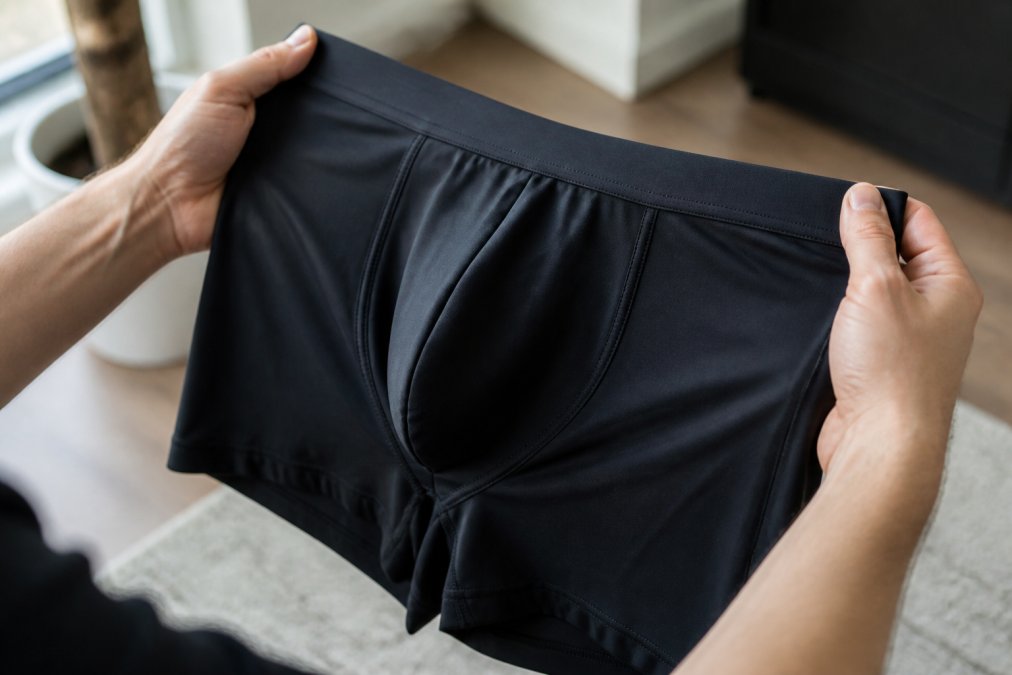
What sets this pair apart is the longer anti-ride-up legs combined with the four-way stretch fabric. The legs stay in place through squats, cycling, and long walks without bunching. The comfortable waistband lies flat under dress pants and athletic wear alike, maintaining its elasticity wash after wash.
The easy-access central fly deserves specific mention because it functions smoothly without gimmicks. It opens cleanly when needed and lies completely flat otherwise, adding no bulk to the silhouette. For men who wear fitted dress pants or gym clothes, the support holds its shape from morning meetings through evening workouts.
The antimicrobial properties of TENCEL reduce odor buildup, so the pair stays fresh through long days and travel. At $19.60, this boxer brief delivers performance that justifies the investment.
Fit, Durability, and Skin Sensitivity: What to Check Before Buying
Most buying guides treat fit as a one-size-fits-all proposition, but premium underwear fails or succeeds based on how well it accommodates your specific frame. Generic size charts ignore the three measurements that actually determine comfort: thigh circumference, waist-to-hip ratio, and torso length. Here is how to evaluate a pair against your body rather than against a marketing photo.
Fit for Your Body Type, Not a Mannequin
For men with thicker thighs: The leg opening is the first point of failure. A standard 3-inch inseam will ride up relentlessly if your thigh circumference exceeds 23 inches at the midpoint. Look for boxer briefs with a 5-to-6-inch inseam and a leg band that uses elastic recovery rather than a tight hem. A common pattern among athletes is buying one size up for the legs and then suffering a loose waistband; instead, seek brands that offer separate waist and leg sizing or a tapered leg cut that widens slightly toward the hem.
For men with a high waist-to-hip ratio (narrow waist, wider hips): The waistband is your battleground. A straight-cut waistband will roll down or dig in because it cannot follow the curve from your iliac crest to your hip bones. Premium construction uses a contoured waistband that is slightly curved rather than perfectly straight, allowing it to sit flush without pressure points. When testing, bend forward and twist side to side; if the waistband gaps or rolls, it will fail during a normal workday.
For taller men (6'2" and above): The rise is the silent killer. A short rise pulls the pouch downward and creates constant tugging at the waistband. Look for a mid-to-high rise that positions the pouch at your natural anatomical midpoint, not hanging low. A simple test: after putting the underwear on, raise one knee to your chest. If the waistband drops more than half an inch, the rise is too short for your torso.
For men with a larger midsection: The waistband must distribute pressure evenly rather than concentrating it at the front. A wide waistband (1.5 inches or more) with horizontal elastic channels performs better than a narrow band that acts like a rubber band. Also check whether the front panel has enough fabric to accommodate your abdomen without the waistband rolling under the belly. This is where TENCEL's drape matters: it follows your contour instead of tenting out like stiff cotton.
The 50-Wash Durability Benchmark
-
Elastic degradation in the waistband: After 30 washes, cheap waistbands lose 40-60% of their original tension (aatcc.org). You can test this at home: stretch the waistband to double its length and release. A premium band snaps back immediately; a degraded one returns slowly or retains a wave. TENCEL blends with spandex maintain their recovery because the cellulosic fibers do not abrade the elastane the way coarse cotton does.
-
Pilling on the inner thighs: Pilling is caused by friction between your thighs during walking. It appears first on the inner leg seam and the center of the pouch. After 20 washes, run your hand across these areas. If you feel any fuzz or small balls, the fabric will continue to degrade. Flatlock seams reduce pilling because they eliminate the raised edge that rubs against itself.
-
Shape retention in the pouch: The pouch is the first area to lose its three-dimensional structure. A premium pouch uses a separate piece of fabric with its own stretch characteristics, not just a dart sewn into the front panel. After 50 washes, the pouch should still hold its cup shape when laid flat. If it flattens into a single layer, the structural integrity is gone.
-
Color fading: Dark colors fade visibly by wash 30 if the dye is low quality. TENCEL Lyocell accepts fiber-reactive dyes that bond at the molecular level, which is why premium brands can offer deep blacks and navies that stay rich. Compare the waistband color to the body fabric after several washes; if the waistband has faded but the body has not, the dye process was inconsistent.
Skin Sensitivity: The Hidden Variable
Contact dermatitis in the groin area is more common than most men admit. The triggers are rarely the fabric itself; they are the chemical finishes applied during manufacturing. Formaldehyde-based wrinkle-resist treatments, optical brighteners, and azo dyes are the usual culprits. If you have experienced itching, redness, or a burning sensation with other underwear, here is what to check before buying premium:
-
Look for OEKO-TEX Standard 100 certification. This is a well-known, third-party certification that tests for harmful substances, including the specific chemicals that cause contact dermatitis. It is not a marketing claim; it is a laboratory standard.
-
Avoid optical brighteners. These are added to make white fabrics look brighter, but they are a common irritant. If you prefer white underwear, choose unbleached or naturally colored options.
-
Understand the role of fiber smoothness. Under a microscope, cotton fibers have a ribbon-like structure with rough edges that create micro-abrasions against sensitive skin. TENCEL Lyocell fibers are round and smooth, which is why dermatologists often recommend it for people with eczema or general sensitivity. The smooth surface also means less friction, which translates directly to less chafing during movement.
-
Test before you commit. If you have known sensitivities, buy a single pair first and wear it for three consecutive days. Wash it once before the first wear to remove any residual processing chemicals. If you experience no irritation after 72 hours of continuous wear, the fabric is likely safe for you.
The 72-Hour At-Home Test Protocol
Day 1 (Sedentary): Wear the pair for 8 hours while working at a desk. Note any waistband pressure, pouch shifting, or leg ride-up. Sit, stand, and bend repeatedly.
Day 2 (Active): Wear the pair for a 45-minute workout that includes squats, lunges, and running. Then wear them for 2 more hours afterward to assess moisture management and odor control.
Day 3 (Wash Test): Machine wash the pair in cold water with your regular detergent. Do not use fabric softener. Air dry or tumble dry on low. After drying, check the waistband tension, seam integrity, and whether the pouch retained its shape.
Which Premium Men's Underwear Brand Should You Choose?
The right premium underwear depends less on brand loyalty and more on matching construction to your specific priorities. Here is a decision framework that accounts for the trade-offs most guides ignore.
Decision Matrix: Match the Brand to Your Lifestyle
If you prioritize all-day comfort across varied activities (office, commute, gym): Look for a brand that combines a patented anatomical pouch with a longer anti-ride-up leg. The Helux Gear 2nd Edition boxer brief delivers this combination through its 92% TENCEL Lyocell and 8% spandex blend. The TENCEL provides moisture-wicking and natural softness, while the spandex delivers the four-way stretch recovery needed for movement. The longer leg (5 inches) prevents the bunching that shorter cuts cause during squats or cycling. This is the best choice for men who do not want to change underwear between work and workout.
If you prioritize environmental responsibility: TENCEL Lyocell is the clear winner among mainstream options. Its production uses approximately 95% less water than cotton farming and relies on a closed-loop solvent recovery process that recycles over 99% of the water and solvent used (lenzing.com). This is a well-documented public fact about the Lyocell manufacturing process. If this matters to you, verify that the brand discloses its fabric sourcing and any third-party certifications. Helux Gear uses TENCEL Lyocell, but you should also check for brands that publish their supply chain audits.
If you prioritize maximum breathability for hot climates or heavy sweating: Look for a lighter fabric weight (around 150-180 gsm rather than 200+ gsm). TENCEL performs well here because its fiber structure transports moisture away from the skin more efficiently than cotton, but the fabric weight matters as much as the fiber type. A lightweight TENCEL blend will feel cooler than a heavyweight one, even from the same brand.
If you have sensitive skin or a history of contact dermatitis: Prioritize OEKO-TEX Standard 100 certification and smooth-fiber construction. TENCEL Lyocell's round, smooth fibers create less friction than cotton's ribbon-like structure, which is why it is frequently recommended for sensitive skin. Avoid brands that use optical brighteners or heavy chemical finishes. If you are unsure, buy a single pair first and run the 72-hour test protocol described in the previous section.
Cost Per Wear: The Metric That Matters
Premium underwear is not expensive when you calculate cost per wear. A $19.60 pair that maintains its performance through 100 wears costs $0.20 per wear. A $10 three-pack that loses its waistband elasticity and shape by wash 20 might last 60 total wears across all three pairs, which is $0.17 per wear. The difference is negligible, but the premium pair provides consistent comfort for every one of those wears, while the cheap pair becomes uncomfortable around wear 15.
The real cost comparison is against the middle tier. A $15 pair that lasts 50 wears costs $0.30 per wear, which is actually more expensive than the $19.60 pair that lasts 100 wears. The key is durability, not price.
The Helux Gear Position: What We Do and Do Not Claim
Helux Gear occupies a specific position in the premium market: we engineer for the intersection of comfort, durability, and anatomical correctness. Our patented pouch design addresses the structural failure common in flat-front briefs, and our TENCEL microfiber construction addresses the moisture and skin-sensitivity issues that plague cotton.
What we do not claim is that we are the best choice for every man. If you prioritize the absolute lightest fabric for tropical climates, a different construction may suit you better. If you prefer a longer trunk-style leg, our boxer brief cut may not match your preference. If you want a completely seamless design, our flatlock seams, while smooth, are still visible.
What we do claim is verifiable: our 2nd Edition boxer briefs use 92% TENCEL Lyocell and 8% spandex, feature a patented anatomical pouch, and are constructed with anti-ride-up legs that maintain position through movement. The price of $19.60 reflects the material cost and construction quality, not a brand markup.
Final Recommendation Framework
- Measure your thigh circumference and torso length before you buy anything. This takes two minutes and eliminates most fit failures.
- Check the fabric composition. TENCEL Lyocell blends (85-95% TENCEL with 5-15% spandex) offer the best balance of moisture management, softness, and stretch recovery.
- Verify certifications. Look for OEKO-TEX Standard 100 if you have sensitive skin.
- Buy one pair first. Run the 72-hour protocol. If it passes, buy more. If it fails, you have lost $20, not $100.
- Wash correctly. Cold water, no fabric softener, low heat drying. This single habit doubles the lifespan of any premium pair.
This framework applies whether you choose Helux Gear or another premium brand. The goal is not to sell you a specific label; it is to ensure you stop enduring daily discomfort and start wearing underwear that performs.
Frequently Asked Questions
Do expensive underwear brands actually last longer?
Often, yes, but the price should reflect materials and construction, not just the label. Premium men's underwear brands typically use higher-grade fabrics like TENCEL lyocell and spandex blends that hold elasticity through dozens of washes. Cheaper pairs lose shape and waistband tension within months. Look for reinforced flatlock seams and fabric that resists pilling. A well-made pair at $19.60 offers superior value.
Which fabric is best for premium men's boxer briefs?
For most men, a TENCEL lyocell and spandex blend offers the best balance. TENCEL is a men's underwear fabric comparison winner because it wicks moisture better than cotton, feels softer than most synthetics, and resists odor naturally. The 8% spandex provides four-way stretch so the briefs move with you. Cotton is breathable but traps sweat, while pure synthetics like nylon can hold heat. If you want temperature regulation and chafe-free comfort through a full day, TENCEL blends are the clear choice.
What is an anatomically correct pouch in men's underwear?
An anatomically correct pouch is a contoured front compartment designed to hold everything in a natural, forward position instead of flattening it against the body. The benefits of pouch underwear include reduced chafing, better airflow, and a more defined silhouette under fitted clothing. Unlike standard flat-front briefs, the pouch provides support without compression. Look for one with stretch so it adapts to your size, plus an ergonomic central fly for easy access without awkward fishing.
How often should you replace your men's underwear?
Replace everyday pairs every 6 to 12 months. Signs it's time include sagging waistbands, thinning fabric, holes, or loss of elasticity. If you rotate through five pairs weekly, premium boxer briefs made from TENCEL and spandex generally hold their shape. Athletic pairs worn for workouts may need replacing sooner due to more sweat and friction. When the pouch no longer supports or the legs start riding up, it's time for new ones.
0 comments